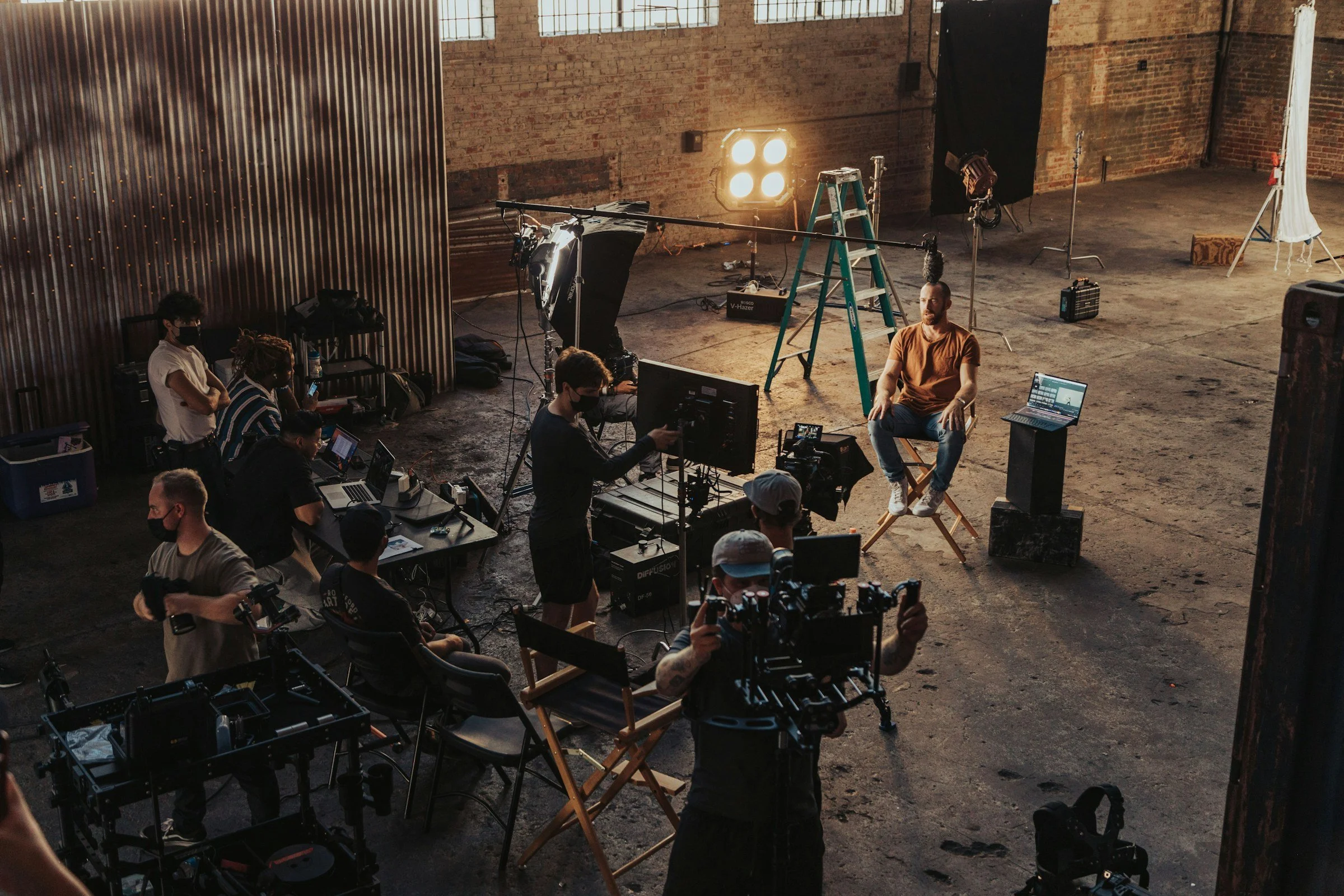
There's no single number, and anyone who hands you one before they know what the spot needs is guessing. What a commercial costs comes down to what the production asks for: the creative idea, the talent, the crew, the locations, the equipment, the shooting schedule and the editorial work after the shoot. Two spots with the same running time can sit nowhere near each other on a budget.
So the more useful question isn't how much a commercial costs. It's what in this commercial is driving the cost. Here's that, line by line.
What does a commercial production budget cover?
Commercial production cost is the people, resources and creative work it takes to develop, shoot and finish an advertisement. It's more than the hours spent recording footage. A budget has to carry the preparation, the shoot, the editorial and finishing, and the deliverables at the end.
What scopes it is the creative idea and what that idea practically requires. A single product spot in one location asks for less. A campaign with several locations, a cast, complicated setups or heavy visual finishing asks for more. Running time won't tell you which one you're looking at. The length of a commercial says almost nothing about the work inside it.
What drives the cost of a commercial?
The main drivers are the creative concept, pre-production, talent, crew, locations, equipment, the shooting schedule, post-production and deliverables. Each one moves with the project, which is why it's worth reading a budget in parts rather than as one lump sum.
1. Creative development & concept
Every commercial starts with an idea, and the idea sets everything downstream: the visual direction, the narrative, the approach. A straightforward product spot needs less development. A story-driven campaign needs more, and more coordination with it. The ambition of the concept is what decides how much has to be built to get it on screen.
2. Pre-production & planning
Pre-production turns the concept into a plan someone can actually shoot. More performers, more locations and more scenes mean more preparation. Paradise's Commercial Video Production in Chicago, IL page lists what this stage covers on a commercial job:
Concept development & creative treatments
Scriptwriting & storyboarding
Casting & talent direction
Location scouting
Scheduling & logistics
3. Directors, producers & crew
A commercial needs people with the right creative and technical skills. Directors guide the visual storytelling and producers hold the practical pieces together, while cinematographers, camera operators, lighting crew and sound crew do the work on the day. Camera operators and film and video editors are counted as separate occupations by the U.S. Bureau of Labor Statistics, which is a fair reminder that a crew is a group of specialists and not one line item. Crew size follows the complexity of the shoot.
4. Talent, casting & performance
The number and type of performers change what a production needs. One performer is one set of requirements; an ensemble is another. On a commercial, the talent line covers more than the shoot day. How performers are cast and directed, how they're dressed and groomed, and the right to run the finished spot all sit in that same part of the budget, whoever ends up handling each piece. Under the SAG-AFTRA 2025 Commercials Contracts, performers are paid a session fee and then use fees that depend on the use type the spot runs in and the length of the use cycle, so where a commercial is going to run belongs in the conversation early.
5. Locations, sets & art direction
Where you shoot shapes what the shoot needs. An existing location may need very little preparation, while a built set or a heavily dressed environment needs a lot. Access, transport, props, set dressing and art direction all land in the same part of the budget. The City of Chicago issues film permits for filming on streets, sidewalks, alleys and other public properties, though low-impact shoots that don't interfere with traffic typically don't need one, and street closures and other high-impact logistics take extra review time.
6. Camera, lighting & production equipment
Camera, lighting and sound equipment follow the look you're after, the conditions you're shooting in and the technical specs you have to hit. The aim is the right package for the job, not the biggest one available:
Camera systems & lenses
Lighting equipment & accessories
Sound recording equipment
Camera support & rigging
Monitoring & playback
Specialist equipment for particular shots
7. Shooting days & production complexity
The schedule depends on how much footage is needed and how complicated each setup is. Multiple scenes, locations, performers and lighting arrangements all add shooting time. Even a single location can mean several camera setups and relights. A short spot doesn't mean a short shoot.
8. Editing & post-production
Post is where footage, sound, graphics and finishing come together as a commercial. The work can include editing, music, sound design, color, motion graphics and visual effects, and the editorial requirement follows the creative direction and the complexity of the finished piece. Paradise lists this under Editorial & Post-Production Services, a page that describes a span from concept development and scriptwriting through filming, editing and post-production.
9. Deliverables & final versions
A campaign usually needs more than one version. Settle those before you shoot, because they change the plan on the day as much as they change the edit:
Video aspect ratios
Shorter edits & cutdowns
Platform-specific versions
Alternate creative arrangements
Technical delivery specs
Cost drivers at a glance
| Cost driver | What influences the requirement |
|---|---|
| Creative development | Concept complexity, scripting and visual direction |
| Pre-production | Planning, casting, scheduling and logistics |
| Directors and crew | Number of roles and specialist skills needed |
| Talent | Number of performers, casting and use rights |
| Locations and sets | Access, preparation, permits, props and construction |
| Equipment | Camera, lighting, sound and specialist technical needs |
| Shooting schedule | Number of days, scenes and setups |
| Post-production | Editing, sound, color, graphics and finishing |
| Deliverables | Number of versions, formats and final assets |
No single line decides a budget. It's the relationship between them that sets the scope.
Why can two commercials of the same length cost different amounts?
Two spots with the same running time can sit nowhere near each other on a budget: the length of a commercial says almost nothing about the work inside it. Picture two thirty-second spots. The first is one performer in one location, a tight concept, a controlled setup and a straightforward edit. The second tells a bigger story: several performers, a few locations, more complicated lighting and more finishing in post.
Both run thirty seconds. Their production requirements aren't comparable. That's the difference between screen time and production scope, and it's why a budget should be read against what the creative needs rather than against the clock.
How can you plan a commercial budget more effectively?
A clear brief is the most useful thing you can bring to the conversation. Before you ask for an estimate, settle what the commercial has to do and what has to be delivered. Seven questions get you most of the way:
What's the creative objective? The message, the audience, the response you want.
What's the visual direction? A simple setup, or a built environment.
Who needs to appear? Talent requirements and how the spot will be used.
Where are you filming? Location requirements and practical access.
What production resources are needed? Crew roles, equipment, technical requirements.
What are the final deliverables? Formats, versions and where they're running.
What does post involve? Editorial, sound, graphics and finishing expectations.
Answer those and a production partner can tell you what the work actually involves instead of guessing at it. They also make for a better conversation about ambition, constraints and priorities, whether the job is a commercial or one of the other project types listed on Paradise's Work With Us page.
Where Paradise fits
Paradise is a Chicago video production company that works with ad agencies and direct-to-client teams through three services: Co-Creating, Full Service Production and Editorial & Post-Production. We are a full service production company that creates commercial work with agencies and brands from pre-production through post. We believe the best videos feel real, not staged.
A strong commercial needs more than a good idea. It needs a production that carries the idea from planning through the shoot and into post.
While we're rooted in Chicago, our team travels for clients nationwide. There's more on how the production side works on Full Service Video Production Services, and more on the local picture on Chicago Video Production Company.
Frequently asked questions
How early should you bring in a production company?
As early as the concept stage. The four process steps Paradise publishes are Discovery, pre-production, production and post-production.
What's the difference between an agency-led and a direct-to-brand production?
On an agency-led project, the agency owns the creative strategy and the production partner executes it. Direct to brand, the production company may also contribute to concept development. Which model fits depends on the creative resources a brand already has in place.
How do usage rights and licensing affect a commercial's scope?
Usage comes down to where a commercial runs, in what media and for how long. Performer payments follow that directly under the SAG-AFTRA 2025 Commercials Contracts, where use fees track the use type and the use cycle. Music and footage you didn't create belong to somebody else, and a copyright owner holds the exclusive rights to reproduce, distribute and publicly perform the work, so using it means licensing it or getting permission another way. Define all of it before you shoot.
Can one shoot produce content for more than one campaign?
Yes, if you plan it that way. Deciding on the extra deliverables, social cutdowns or alternate edits before the shoot lets the team capture what's needed while everyone's on set.
Who do we talk to about budget?
Email Tracy Tran-Thomas, Executive Producer, at tracy@paradise.love. Paradise doesn't publish prices or packages, because the production is what sets the number.
For all new business inquiries, email Tracy Tran-Thomas, Executive Producer: tracy@paradise.love