

How to choose a Chicago film and video studio
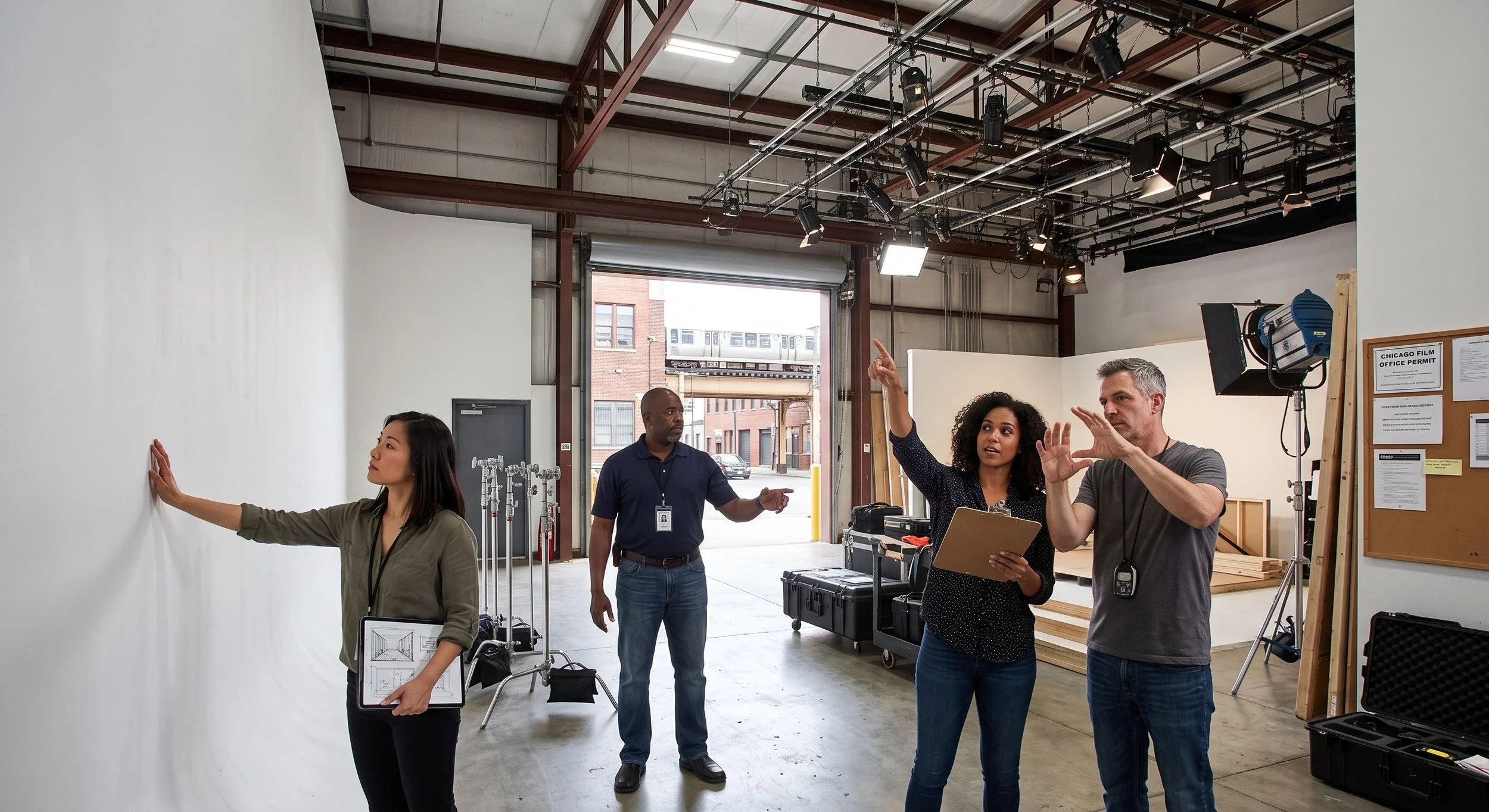
The right studio does more than give you four walls and a floor to shoot on. It gives an idea somewhere to become real.
If you're weighing a Chicago film and video studio for your next shoot, size and lighting are usually the first things on the list. They matter. But the right space also has to fit your crew, your schedule and the concept itself, from the first walkthrough to the last setup of the day.
Chicago has everything from compact controlled spaces to large soundstages. Here's what to look for, and how to pick a space that works for the production you're actually making.
What is a film and video studio?
A film and video studio is a controlled space for shooting commercials, branded content, interviews and narrative projects. Depending on the space, you might find lighting, sound control, green screens, cyc walls, dressing rooms, equipment and crew support.
The big advantage is control. You shape light, sound, camera movement and set design around the story, and conditions stay consistent from the first take to the last.
Studio or location: which does your shoot need?
A location gives you authenticity. A studio gives you control. Neither one is automatically better. It comes down to what the production needs.
A studio makes sense when the concept calls for a controlled visual environment. You can manage lighting, build sets and design each frame without adapting to whatever the day throws at you. It also pulls equipment, crew, talent prep and set construction into one place, which helps when you've got several setups to get through.
Here's how the two stack up side by side.
| Consideration | Studio production | Location production |
|---|---|---|
| Lighting | Highly controllable | Depends on the environment |
| Sound | Easier to manage | Can be affected by surroundings |
| Set design | Built around the concept | Limited by the existing space |
| Camera movement | Space can be chosen for the shot | Space may restrict movement |
| Weather | Not a major variable | Can affect the schedule |
| Visual consistency | Easier to maintain | May vary across locations |
| Logistics | One production base | May need several locations |
The goal isn't to pick the option that sounds more professional. It's to pick the environment that gives the production the freedom it actually needs.
If part of your shoot moves outside, the City of Chicago issues permits for filming on streets, sidewalks, alleys and other public property. The Chicago Park District, Navy Pier, Millennium Park and the Chicago Transit Authority issue their own filming permits. The Chicago Film Office is the liaison for City of Chicago production needs, including permits, city services, and logistical support. Shooting somewhere else in Illinois? The Illinois Film Office doesn't issue filming permits. Permits come from the municipality where the filming takes place.
Where Paradise fits
We are a full-service production company that creates commercial work with agencies and brands from pre-production through post.
On our Chicago Video Production Company page, pre-production includes:
Creative concepting and treatments
Scriptwriting and storyboarding
Casting and talent management
Location scouting across Chicago
Scheduling, budgeting, and logistics
What should you look for in a film studio?
Not every studio suits every kind of production. A space that's great for an interview may be too tight for a large commercial, or have no room for serious set construction. Start with what the project demands.
Size and ceiling height
Floor space and ceiling height both matter. A bigger space gives you room for cameras, lighting, sets, props, talent, and gear. Before you commit, map out the whole production footprint, including the space behind the camera, lighting, wardrobe, props and crew. A studio that feels roomy on a tour can get tight fast once the trucks are unloaded.
Lighting infrastructure
Look past the equipment list and ask how easily the space supports your lighting plan. Check for overhead rigging, enough power, and room to build different setups without tearing everything down between them.
Sound control
Great visuals can't rescue bad audio. For interviews, dialogue, and narrative work, think about sound early. Traffic, construction, aircraft, neighbors, and building systems all make noise. A controlled space gives your audio team a quieter, more predictable room.
Cyc walls and green screens
Some productions want a clean, unbroken background. Others need a background that can be replaced in post. A cyc wall creates a continuous surface without visible corners, while a green screen supports compositing and visual effects. You won't need either on every project. It depends on the look and the technical plan.
Which support spaces matter?
A studio is more than the shooting floor. Look for talent holding, dressing and wardrobe space, hair and makeup, a production office, equipment storage and a client viewing area.
The unglamorous stuff counts too: load-in access, parking, kitchens, reliable internet, restrooms and somewhere for the crew to take a breather. None of it shows up on camera, but it all shows up in how the day feels.
How does location affect a studio shoot?
Where the studio sits in the city changes how smoothly a shoot runs. Think about parking, loading access, major routes, and how easily crew and gear can get in and out.
On bigger productions, small logistical snags cost real time. The best spot isn't always the one closest to downtown. It's the one that fits the production's practical needs.
How should you evaluate a studio before you commit?
Treat a studio tour as part of pre-production. Don't just walk through and decide whether it looks good. Bring your production requirements with you.
Start with the shot
Before you judge a space, clarify what has to happen inside it. How many cameras? How much movement? What's the lighting setup, how much set construction is there, how many wardrobe changes, and where will the client sit?
Ask the technical questions
Be specific. Confirm:
Usable shooting area and ceiling height
Power capacity and rigging options
Lighting equipment on site
Sound conditions
Cyc wall or green screen availability
Talent, wardrobe and makeup areas
Load-in route and parking
Rules on set construction
Access hours and how much time you're actually getting
Don't assume a feature exists because it shows up in a photo. Ask. Those answers tell you far more than a gallery ever will.
Think about crew flow
A good space lets each department work without tripping over the others. Camera, lighting, art, talent, and production all need room to operate. Picture how people and gear will move through the building, not just how the final frame will look.
When should you start looking?
Start during pre-production, before the concept is locked. Thinking about the space early shows you what the project will realistically need, especially if you're planning set builds, specialized lighting, multiple shoot days, large equipment, or a big crew.
It helps to write a short production brief first. List the project type, shoot days, number of talent and crew, and your camera, lighting, sound, set, and equipment needs. Add client needs, parking, load-in, and the schedule. Now you're not asking "Which studio looks best?" You're asking "Which studio can support this production?" That's the better question.
A gorgeous space that can't fit your schedule isn't the right one. Neither is a technically capable space that forces the creative team to shrink the idea.
How does the right studio serve the concept?
Pick a studio because it makes the production possible, not because it's impressive.
Picture a concept built on slow camera moves, controlled shadows, carefully shaped light and a large practical set. A studio with a low ceiling and not much floor space will box you in right away.
Now picture an interview series that needs controlled lighting, quiet sound, a few backgrounds, and a compact crew. A smaller space could be perfect.
The right space changes with the story. That's why choosing it belongs in the creative conversation, not just the budget.
The studio is part of the story
A production space is never just a room. It shapes what the camera sees, how the crew works, and how confidently an idea comes to life.
So start with one question: what does this story need from the space? The right studio doesn't compete with the idea. It gives the idea somewhere to live.
Frequently asked questions
What's included in a film studio rental?
It varies. A rental may include the shooting space, basic lighting infrastructure, power, production areas and other amenities. Equipment, crew support, set construction and specialized services differ from studio to studio, so confirm exactly what's included before you commit.
Do I need to bring my own filming equipment to a studio?
Not always. Some studios provide cameras, lighting, grip or sound equipment, and others offer the space only. Compare the studio's equipment list with your production requirements before you decide what to bring or rent.
Can I build a custom set inside a film studio?
Often, but restrictions can apply based on the building, floor space, rigging, materials and schedule. Check construction policies, load-in requirements and what you'll need to restore before you sign on.
How do I know if a studio can support my crew size?
Look past the listed square footage. Account for cameras, lighting, equipment, talent, the art department, wardrobe, client viewing and crew movement. Every department should have room to work without getting in each other's way.
What costs should I plan for beyond studio rental?
Think about equipment rentals, crew, set construction, transportation, parking, overtime, catering, insurance and specialized production services. Spotting these early helps you build a more realistic budget.
Let's get in touch!
For all new business inquiries, email Tracy Tran-Thomas, Executive Producer: tracy@paradise.love